Campground Operations
The Campground Safety Walkthrough: Lighting, Signage, Play Areas, and Documentation Habits
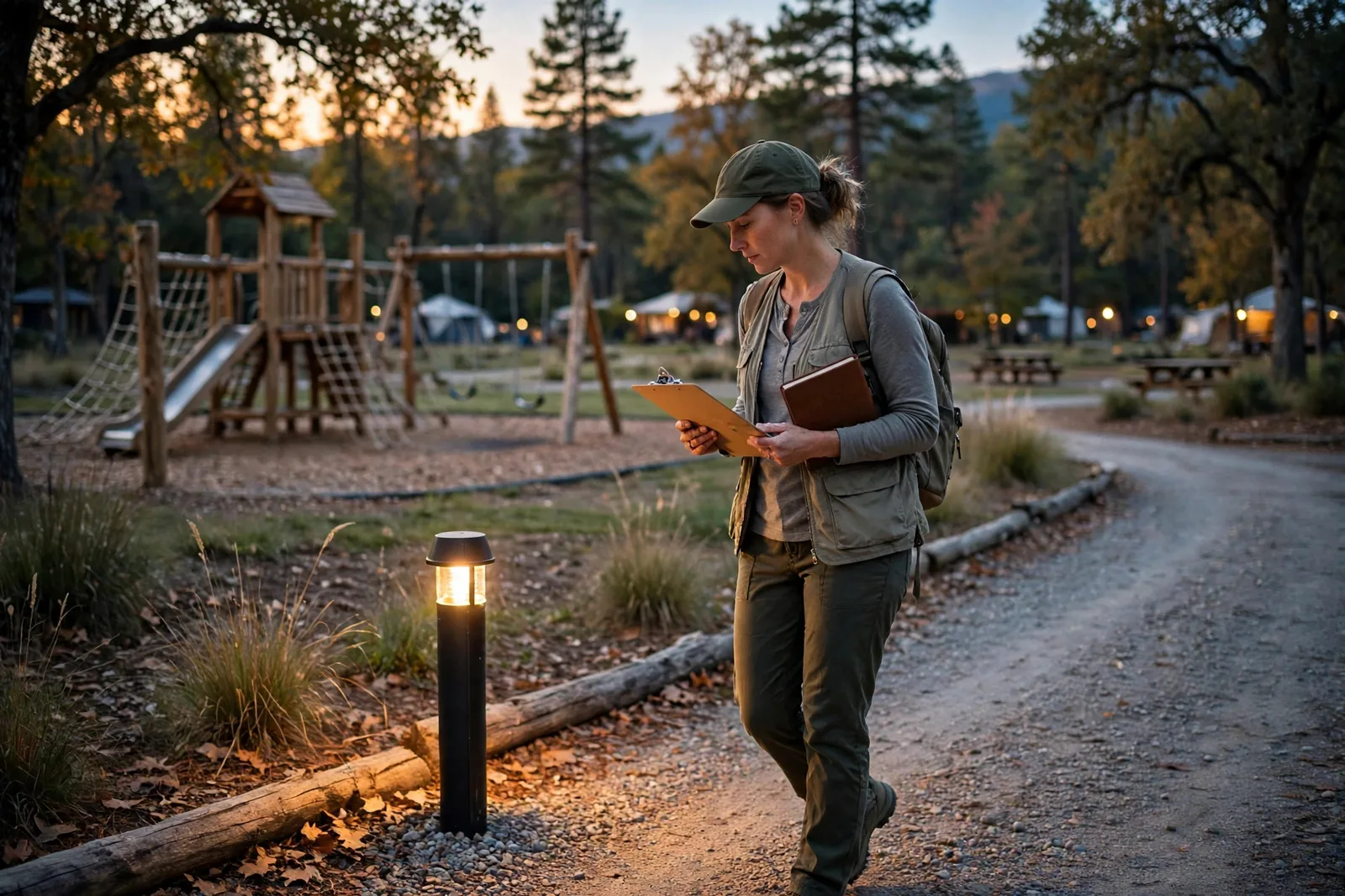
A safety walkthrough is not a stroll with a worried expression. It's a scheduled inspection — same route, same checklist, same documentation — that turns "we keep an eye on things" into something that actually protects guests, staff, and the business. This article is general information about widely recognized standards and good practice, not legal or engineering advice; your state and local codes, your insurer, and your attorney all get a say that this article doesn't.
Do the walk twice: once in daylight, once after dark. Half of what you're checking for only exists at night.
Lighting: walk the guest's route, not yours
Guests move between their site, the bathhouse, the store, and the dump station in the dark, often carrying something, often with kids. Walk exactly those routes after sunset and look for the dark gaps between fixtures — the unlit stretch is where the twisted ankle happens, regardless of how good the lit stretches are.
Check for burned-out fixtures (bring the replacement list, not just a mental note), fixtures aimed into eyes rather than at the ground, and lighting at every change of level: steps, ramps, dock edges, and the dump station pad. Pedestal lights at sites are part of this too — a guest connecting a sewer hose at 10 p.m. is doing close work in whatever light you gave them.
Fact: for your staff areas, federal OSHA rules set the baseline expectation. Under 29 CFR 1910.22, employers must keep walking-working surfaces clean, orderly, and free of hazards such as spills, loose boards, snow, and ice — and must inspect those surfaces regularly and correct hazards before employees use them again. Your guests aren't covered by OSHA, but a path that's safe for a workamper at 6 a.m. is usually safe for a guest at 10 p.m. It's a sensible floor to hold the whole property to.
Signage: the sign audit nobody does
Signs fail quietly: they fade, get overgrown, fall, or — most common — say something that stopped being true two seasons ago. On the walk, read every sign as a first-time guest:
- Wayfinding: Can a guest arriving after dark find their site, the bathhouse, and the office from the entrance, in a vehicle, without stopping in the road?
- Rules that prevent emergencies: Speed limit where kids and bikes mix with rigs. Fire rules and firewood policy. Pool rules and hours, if you have one.
- Emergency information: Your park's address — the one a panicked guest reads to a 911 dispatcher — posted at the office and bathhouse, plus the location of the nearest hospital. Guests routinely don't know the address of the place they're staying. Post it where they'll be when they need it.
- Weather shelter: Where do tent guests go in severe weather? Which brings up a fact worth posting and teaching: the National Weather Service's guidance is "when thunder roars, go indoors" — into a substantial, fully enclosed building, not a tent, picnic shelter, or pavilion, which do not protect from lightning — and to wait at least 30 minutes after the last thunder before resuming outdoor activity. Your bathhouse is likely your shelter; say so on the sign, and make sure staff know the drill.
A sign that contradicts another sign — old quiet hours here, new ones there — is worse than a missing sign. Retire the stale ones on the spot.
Play areas: the standards are written down
Playgrounds are where good intentions meet actual written standards, so this is the section to be most careful with.
Fact: the 2010 ADA Standards for Accessible Design include specific requirements for play areas (Section 1008). For newly constructed or altered play areas, they require an accessible route into and through the play area, ground-level play components on that route, and at least half of elevated play components reachable by an accessible route — with surfacing on accessible routes that is firm and stable. The standards have applied to new construction and alterations since March 15, 2012. Whether and how they apply to your existing playground depends on its age and any alterations you've made — that's a question for a qualified accessibility consultant or your attorney, not a blog post.
What the walkthrough itself checks, regardless of legal status:
- Surfacing: depth and displacement under swings and slide exits — the high-impact zones wear thin first.
- Hardware: protruding bolts, open S-hooks, cracked swing seats, splintered wood, rusted chains. Run a hand (carefully) where kids run theirs.
- Entrapment and pinch points: openings and moving joints, checked against the manufacturer's guidance for your equipment.
- Sight lines: can a parent at the nearest bench see the whole structure?
Anything that fails gets the area closed — a rope and a sign — until it's repaired. A closed playground is a disappointment. An open, broken one is an injury with a date on it.
Paths, roads, and the humble trip hazard
Walk every path looking down: heaved roots, washed-out gravel edges, hose and cord crossings, low branches at head height on the way to the bathhouse. Check speed bumps and drainage dips for crumbling. At the dump station and water fill, look for the slick spot — algae and standing water on concrete are a slip waiting for a witness.
The habit that makes it all count: documentation
Our take: the walkthrough's real product is not the looking. It's the record. Keep a dated log: route walked, by whom, what was found, what was fixed on the spot, what was scheduled, and when the fix was verified. Photograph defects and repairs with timestamps.
That log does three jobs. It makes sure findings don't evaporate between weekends. It shows your insurer — and, if it ever matters, a court — a pattern of regular, documented care rather than a claim that you cared. And it feeds your preventive maintenance system, so the burned-out bathhouse light becomes a scheduled task with a name on it instead of a memory. (We wrote about building that rhythm in our article on preventive maintenance systems.)
Walk it monthly in season, at opening and closing, and after any major storm. Same route, same checklist, same log. Safety at a campground isn't a project. It's a lap you keep walking.
RVeyOS is currently in development — including inspection checklists and maintenance records that stay attached to the park, not to whoever happened to walk that week. Join the waitlist at rveyos.com for launch updates and early access news.