Guest Experience
De-escalation at the Camp Office: Handling an Angry Guest in Person, Step by Step
Everything in this article is professional opinion — the practiced craft of people who have stood behind camp office counters for years. There is no scientific formula for an angry guest. There is a sequence that works far more often than improvising does, and it can be learned, rehearsed, and taught to every host on your team.
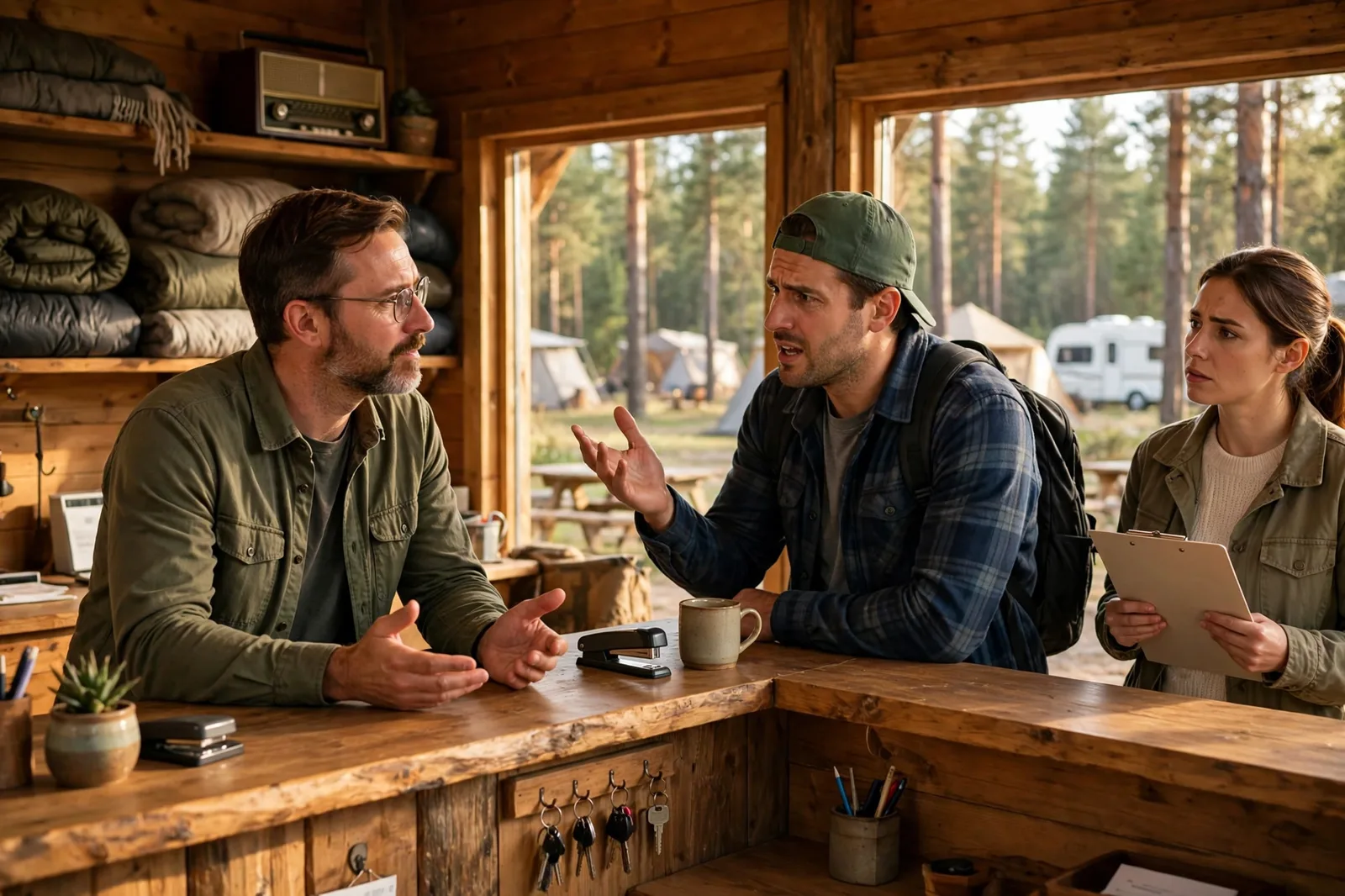
The scene is familiar: a guest comes in hot. The site isn't what they expected, the neighbors were loud, the Wi-Fi is down, the weekend is ruined and it's somehow your fault. Their voice is up, other guests are watching, and the next sixty seconds decide whether this ends as a fixed problem or a one-star review with your name in it.
Step 0: Set the stage before anyone is angry
De-escalation starts before the incident. Keep the counter between you and guests — it's a natural, non-confrontational boundary. Know where your exits are and never let a guest get between you and the door. If your office layout lets a lone evening host be cornered, change the layout, not the host.
Fact: OSHA's workplace-violence guidance — written for healthcare and social service settings, but built on principles that apply to any public-facing workplace — recommends exactly this kind of preparation: a written prevention approach, staff training for incidents, and recordkeeping afterward so patterns get noticed. A campground office is lower-risk than an emergency room, but "we trained for this and we write it down" is the right posture at any scale.
Step 1: Regulate yourself first (10 seconds)
Your voice, face, and posture are the thermostat. Before you answer: breathe out slowly, drop your shoulders, uncross your arms, and consciously slow your speech by a third. Speak lower and quieter than the guest, not louder. People mirror what faces them; give them calm to mirror.
Never match sarcasm, never correct their facts mid-rant, and never say "calm down" — in the entire history of angry people, it has not worked once.
Step 2: Let them finish, and prove you heard it
Most escalations are powered by one fear: nobody is going to listen to me. Remove that fear and the volume usually comes down on its own.
- Let them talk without interrupting for the first full pass, even when they're wrong about details.
- Take a note while they talk. Writing signals seriousness better than nodding does.
- Then play it back in one or two sentences: "So the site next to you ran their generator past quiet hours two nights running, and when you mentioned it to the host on duty, nothing changed. Did I get that right?"
That playback is the hinge of the whole encounter. A guest who feels accurately heard shifts from fighting you to solving it with you.
Step 3: Name the problem, own your part
Separate the person from the problem, and own whatever slice of it is genuinely yours: "You're right that quiet hours are our job to enforce, and we didn't. I'm sorry — that's on us." A specific apology for a specific failure is not weakness; it's the fastest credibility you will ever buy.
Where the complaint isn't valid — the site is exactly what the photos show — don't concede facts, but concede feelings: "I can see this isn't the weekend you pictured, and I'm sorry it's started this way. Let me show you what I can do."
Step 4: Offer a choice between real options
Anger feeds on helplessness. Give the guest a decision between two or three things you can actually deliver: move to a different site tonight, a refund of the affected nights, a host visit to the neighbors this evening plus a follow-up at quiet hours. Options you can't deliver — a sold-out park's empty premium site — will detonate the calm you just built.
If nothing can fix it, say so plainly and early, and put the best available remedy on the table: "I can't move the group next to you, and I won't pretend I can. What I can do is refund tonight and help you find a park nearby with availability." Honesty ends arguments that stalling only inflames.
Step 5: Close it, write it, follow up
Agree the specifics out loud — who does what, by when — and then do the unglamorous part: write it down. Date, time, site, what happened, what was offered, what was agreed. That record protects your staff if the story changes later, and it's how you spot the pattern — the same site, the same neighbor problem, the third weekend running — that one incident at a time never reveals.
Then follow up in person the next day, briefly: "Wanted to check last night was quieter." That two-minute visit converts more angry guests into loyal ones than any discount, because it proves the listening wasn't theater.
The lines you do not cross
De-escalation has limits, and your team should know them in advance:
- Threats, slurs, or physical intimidation end the hospitality script. "I want to help you, and I will — and I need you to lower your voice / step back from the counter so we can do that." Once, clearly.
- If you feel unsafe, disengage. Move to a secure area, get a second staff member, and call local law enforcement if the situation doesn't settle. No site fee is worth an injury. Tell your hosts this explicitly, in training, before they need permission in the moment.
- Never touch a guest or their property, and never follow an angry guest to their site alone. Bring a second person, stay in the open, keep it brief.
Train it like you mean it
Our take: run the scenario twice a season with your hosts — one person plays the guest with the generator complaint, the other works the steps. It feels awkward for ten minutes and saves you for ten months. The goal is not staff who never face anger; it's staff who have a practiced first move instead of a panicked one.
The guests who arrive angry are a small minority of the people you'll serve. Handled well, a surprising number of them leave as the guests who tell the story that starts, "The park messed up — and then they made it right."
RVeyOS is currently in development. We're building it so incident notes, guest records, and follow-ups live where your whole team can see them — not in one host's memory. Join the waitlist at rveyos.com for launch updates and early access news.